
Healthy menus in company canteens.
Fresh water dispensers for employee consumption.
Fruit, juices, and water instead of pastries, baked goods, and coffee at work meetings.
Raising awareness and promoting the reduction of alcohol consumption.
Today, the world’s most successful organizations are distinguished not only by what they produce, but by how they make the people who build them feel every day.
The scientific evidence is clear and consistent:
Workplace happiness is no longer an accessory benefit or a well-intentioned gesture:
it is a strategic indicator of sustainability, competitiveness, and organizational success.
When people feel valued, recognized, and connected to a purpose, their minds expand, their performance is boosted, and the company grows with them.
Investing in well-being is not an emotional concession: it is a smart, humane, and profoundly profitable decision.
Arbedjsglæde means the happiness we get from "doing" something.
It is an emotion, a feeling of well-being that comes when we feel good about the work we do, when we feel involved in 'professional commitment'.
Arbedjsglæde is a common word in Denmark that means happiness at work.
In a fundamental sense, happiness in the workplace comes when:
Individual factors such as personality traits, perception level, underlying psychological stressors, and emotional intelligence influence the degree to which we feel comfortable in a professional situation.
The author of the book, "The Happiness Advantage", Shawn Achor, stated that a company with happy employees could increase its sales by 37% and productivity by 31%, which directly contributes to building a high-performance work environment and improves the quality of life for all people involved in the work.
The concept of happiness at work did not exist until a few decades ago, and there's a reason for that. In recent years, we have seen drastic changes in the industrial sector; we now work in positions that did not exist twenty years ago.
Who could have thought of designations like Social Media Manager, SEO Expert, Chief Happiness Officer, Motivational Coach and Speaker, Career Counselor, or Project Coordinator in the 40s and 50s?
With such a wide range of complex tasks to choose from today, it is only fundamental that we can extract true happiness from the work we dedicate ourselves to. Happy employees are mandatory for a growing business.
Being happy is the first step for anything we want to do successfully.
Going to the office, mechanically performing all assigned tasks, and returning home to spend the rest of the day with a drink in hand and the TV in front is an ideal image of an unhappy life.
A happy worker will arrive at the office on time because they respect punctuality and will perform all daily tasks because they enjoy doing so. They will work out of love, not compulsion.
Happiness at work can spread like wildfire. Employees who take pleasure in their work set a great example for others who are less motivated.
For example, when a team leader is happy with their position and work, they can influence their team with more positivity and maintain high functionality within the group. Happiness in the workplace has a direct correlation with increased productivity and improved group performance at work.
A troubled mind can be a storehouse of negative contemplations. When we work out of compulsion and are not passionate about the contribution we make to the organization's success, our minds begin to wear down.
We get stressed, lose focus, and indulge in self-critical thoughts like "I have to quit," "I can't take it anymore," "I'm not worth it," etc.
Conversely, a professional who has strong positive feelings about their work will undoubtedly be more enthusiastic and focused on building themselves up. Instead of focusing on problems, they would look for ways to solve them.
Annie McKee, an international leadership advisor and writer, mentioned in one of her Harvard Business Review publications that when employees are unhappy, their brains begin to disconnect from positive emotions and damage their power of thought and creative reasoning.
She further stated in her article about the link between our thoughts, feelings, and actions. If any of these are broken, it will surely hinder the others. If we feel happy during the 8 hours we spend at work, if we can somehow tap into the threads of positivity that will keep us animated, it can significantly improve our stress responses and redirect our focus to the positive aspects of work life.
If we allow work stress and disappointments to enter our personal space, there is no way we can get rid of them.
Successful professionals who can optimize their work are less likely to suffer from hypertension, heart attacks, substance abuse, and other stress-related disorders.
When we are happy from within, we gain the power to fight illnesses and the will to recover and return to normal.
Remaining physically or mentally ill can bring unprecedented obstacles even at work. We lose the energy to give our best, we focus less on work and more on ailments, and consequently, we kill our productive spirit.
Not only that, but happiness at work also makes us less prone to work-related stress and burdens.
We all like to be surrounded by people who have a positive attitude and are satisfied with themselves. In a happy mood, people are more innovative and inspired. They are willing to improve their existing skills and contribute to creating a fun and creative performance culture at work.
Finding happiness at work helps build strong interpersonal relationships at work and encourages people to work together for the common well-being of the organization they serve. It is the backbone of innovation, loyalty, responsibility, and success.
Happy workers can create a pleasant work environment that is easy for others to manage, and the more people get involved, the better the team will grow.
Arbedjsglæde means the happiness we get from "doing" something.
It is an emotion, a feeling of well-being that comes when we feel good about the work we do, when we feel involved in 'professional commitment'.
Arbedjsglæde is a common word in Denmark that means happiness at work.
In a fundamental sense, happiness in the workplace comes when:
Individual factors such as personality traits, perception level, underlying psychological stressors, and emotional intelligence influence the degree to which we feel comfortable in a professional situation.
The author of the book, "The Happiness Advantage", Shawn Achor, stated that a company with happy employees could increase its sales by 37% and productivity by 31%, which directly contributes to building a high-performance work environment and improves the quality of life for all people involved in the work.
The concept of happiness at work did not exist until a few decades ago, and there's a reason for that. In recent years, we have seen drastic changes in the industrial sector; we now work in positions that did not exist twenty years ago.
Who could have thought of designations like Social Media Manager, SEO Expert, Chief Happiness Officer, Motivational Coach and Speaker, Career Counselor, or Project Coordinator in the 40s and 50s?
With such a wide range of complex tasks to choose from today, it is only fundamental that we can extract true happiness from the work we dedicate ourselves to. Happy employees are mandatory for a growing business.
Being happy is the first step for anything we want to do successfully.
Going to the office, mechanically performing all assigned tasks, and returning home to spend the rest of the day with a drink in hand and the TV in front is an ideal image of an unhappy life.
A happy worker will arrive at the office on time because they respect punctuality and will perform all daily tasks because they enjoy doing so. They will work out of love, not compulsion.
Happiness at work can spread like wildfire. Employees who take pleasure in their work set a great example for others who are less motivated.
For example, when a team leader is happy with their position and work, they can influence their team with more positivity and maintain high functionality within the group. Happiness in the workplace has a direct correlation with increased productivity and improved group performance at work.
A troubled mind can be a storehouse of negative contemplations. When we work out of compulsion and are not passionate about the contribution we make to the organization's success, our minds begin to wear down.
We get stressed, lose focus, and indulge in self-critical thoughts like "I have to quit," "I can't take it anymore," "I'm not worth it," etc.
Conversely, a professional who has strong positive feelings about their work will undoubtedly be more enthusiastic and focused on building themselves up. Instead of focusing on problems, they would look for ways to solve them.
Annie McKee, an international leadership advisor and writer, mentioned in one of her Harvard Business Review publications that when employees are unhappy, their brains begin to disconnect from positive emotions and damage their power of thought and creative reasoning.
She further stated in her article about the link between our thoughts, feelings, and actions. If any of these are broken, it will surely hinder the others. If we feel happy during the 8 hours we spend at work, if we can somehow tap into the threads of positivity that will keep us animated, it can significantly improve our stress responses and redirect our focus to the positive aspects of work life.
If we allow work stress and disappointments to enter our personal space, there is no way we can get rid of them.
Successful professionals who can optimize their work are less likely to suffer from hypertension, heart attacks, substance abuse, and other stress-related disorders.
When we are happy from within, we gain the power to fight illnesses and the will to recover and return to normal.
Remaining physically or mentally ill can bring unprecedented obstacles even at work. We lose the energy to give our best, we focus less on work and more on ailments, and consequently, we kill our productive spirit.
Not only that, but happiness at work also makes us less prone to work-related stress and burdens.
We all like to be surrounded by people who have a positive attitude and are satisfied with themselves. In a happy mood, people are more innovative and inspired. They are willing to improve their existing skills and contribute to creating a fun and creative performance culture at work.
Finding happiness at work helps build strong interpersonal relationships at work and encourages people to work together for the common well-being of the organization they serve. It is the backbone of innovation, loyalty, responsibility, and success.
Happy workers can create a pleasant work environment that is easy for others to manage, and the more people get involved, the better the team will grow.
Happiness at work is not chance or luck: it is science applied to human well-being. Positive psychology and neuroscience have shown that positive emotions expand the mind, strengthen the brain, and enhance performance.
When people experience gratitude, recognition, and purpose, their brains release serotonin, dopamine, and oxytocin: the main chemicals of well-being. These not only improve mood but also strengthen creativity, optimize decision-making, and improve the quality of work relationships.
The evidence is clear: emotionally healthy environments generate greater innovation, reduce stress, and increase engagement. It’s not about working more, but about working better, from a connection to what makes sense.
From Costa Rica —a country that embodies the balance between nature, peace, and well-being— Choose Happiness School integrates these scientific discoveries into an educational model that teaches how to live, lead, and work with purpose.
Because happiness, even at work, is not a luxury…
it is a smart strategy for well-being, health, and sustainable success.
The most visionary organizations have understood that their true capital lies not only in resources but in the integral well-being of the people who comprise them. When a company adopts health and wellness as core values, it transforms its work culture into an ecosystem where people can flourish physically, mentally, and emotionally.
The science of well-being demonstrates that teams that feel cared for and balanced are more creative, collaborative, and productive. Organizational wellness is not about offering isolated benefits, but about building human environments that foster purpose, trust, and positive energy.
At Choose Happiness School, we promote a vision where mental health, emotional nutrition, conscious movement, and healthy relationships are coherently integrated into work life as part of the same philosophy:
a healthy company is born from fulfilled people.
Well-being is not a luxury; it is a new form of leadership.
Because caring for the body, mind, and emotional dimension of those who work with you is the smartest —and also the most humane— decision an organization can make.
Positive Organizational Psychology (POP) is defined as «the scientific study of the optimal functioning of people’s health and groups in organizations, as well as the effective management of psychosocial well-being at work and the development of healthy organizations.
Its objective is to describe, explain, and predict optimal functioning in these contexts, as well as to amplify and enhance psychosocial well-being and the quality of work and organizational life.
Its mission is to discover the characteristics that define a «full organizational life», that is, to understand what positive employees, groups, organizations, and societies are like.
It includes aspects of positive health and well-being in organizations as a fundamental objective to develop positive experiences (such as engagement, positive beliefs, happiness at work, resilience) and their impact on organizational performance, quality of work and organizational life, among other aspects.
Health is understood as a state of total well-being at work that includes physical, mental, and social well-being, and not merely the absence of disease or disorders (WHO, 1948). In December 2013, the concept was expanded to consider mental health as a state of well-being in which the individual is aware of their own abilities, can cope with the normal stresses of life, can work productively and fruitfully, and is able to make a contribution to their community.
Positive Psychology deals with the strengths and positive characteristics of people that lead to their «optimal functioning».
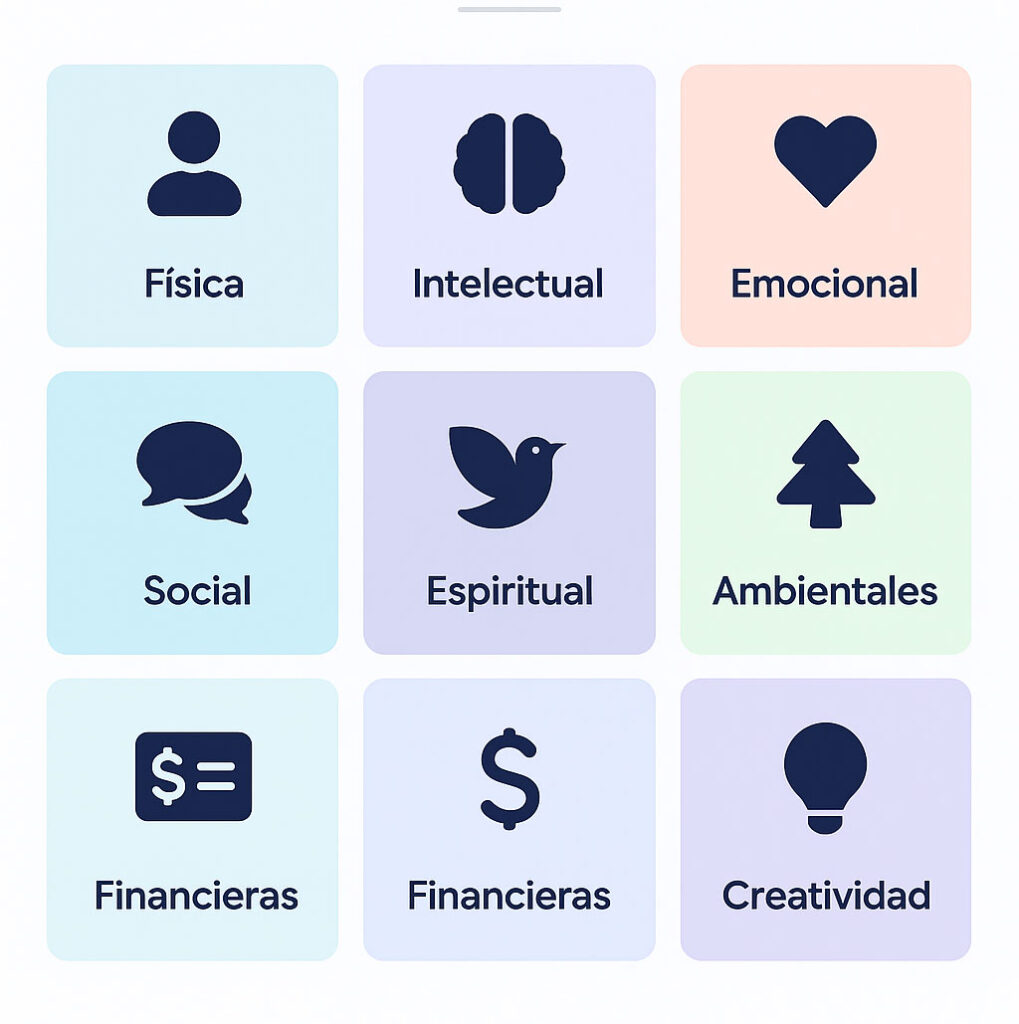
But environmental, financial, and creativity dimensions have also been suggested for consideration.
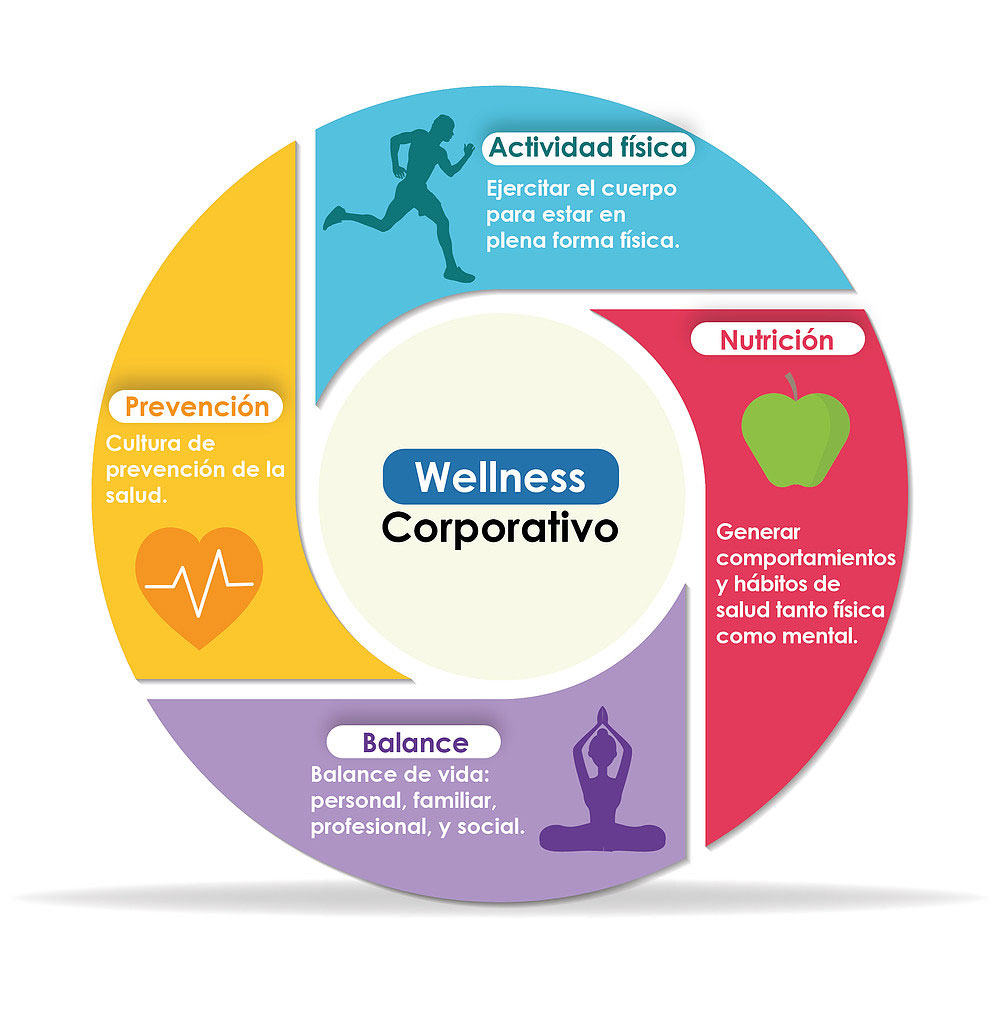
Even when training for self-care and promotion of physical activity and healthy eating is provided, professional and personal development practices are being implemented, recognized as part of organizational happiness practices, where cross-functional work teams that promote Corporate Wellness are also valued, and which, by constituting a collective purpose as a map of meaning, give rise to practices of organizational meaning.
Employees who enjoy wellness in the company promote involvement, and in turn, engaged workers promote organizational wellness in a virtuous circle.
Healthy menus in company canteens.
Fresh water dispensers for employee consumption.
Fruit, juices, and water instead of pastries, baked goods, and coffee at work meetings.
Raising awareness and promoting the reduction of alcohol consumption.
Organizing activities, events, or sports competitions, which will also foster teamwork and healthy competition.